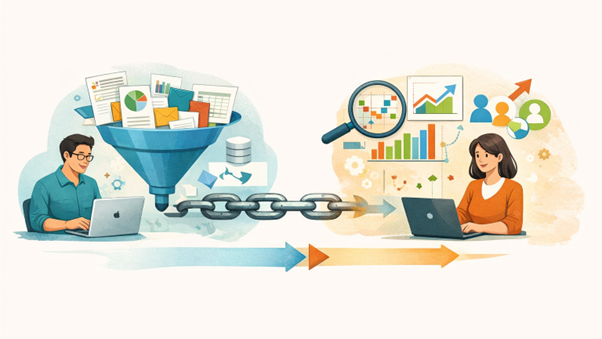
In the era of big data, data quality has evolved from a localized technical concern into a system-level capability that directly affects analytics, artificial intelligence, and decision-making. Many organizations possess vast volumes of data but struggle to extract value due to incompleteness, inconsistency, and noise.
Recent academic research suggests that ensuring data quality requires an integrated technical framework that combines traditional statistical methods, machine learning techniques, and scalable data integration processes. This article synthesizes insights from recent studies and examines their implications for real-world enterprise data systems.
1. The Role of Data Quality in Modern Data Systems

The Role of Data Quality in Modern Data Systems
Data quality is commonly evaluated through dimensions such as completeness, accuracy, consistency, timeliness, and usability. In real-world environments, data collected from heterogeneous sources often violates multiple dimensions simultaneously.
Research consistently shows that poor data quality undermines model performance, increases operational costs, and leads to suboptimal decisions. As a result, data quality must be treated as a core system capability rather than a peripheral preprocessing step.
2. Data Cleaning as the Foundation of Data Quality

Data Cleaning as the Foundation of Data Quality
2.1. Common Issues in Real-World Data
Real-world datasets typically exhibit missing values, duplicates, noise, and inconsistencies across sources. Empirical studies indicate that data preparation consumes a significant portion of effort in data-driven projects.
2.2. Statistical Approaches to Data Cleaning
Statistical techniques remain essential for detecting outliers, imputing missing values, and normalizing data. These methods are transparent, interpretable, and computationally efficient, but they face limitations when dealing with complex, high-dimensional data.
2.3. Machine Learning-Based Data Cleaning
Recent research highlights the use of machine learning to automatically identify data errors, distinguish noise from meaningful signals, and learn latent data patterns. These approaches offer greater adaptability and scalability in large and complex datasets.
3. Data Integration and Quality Challenges at Scale
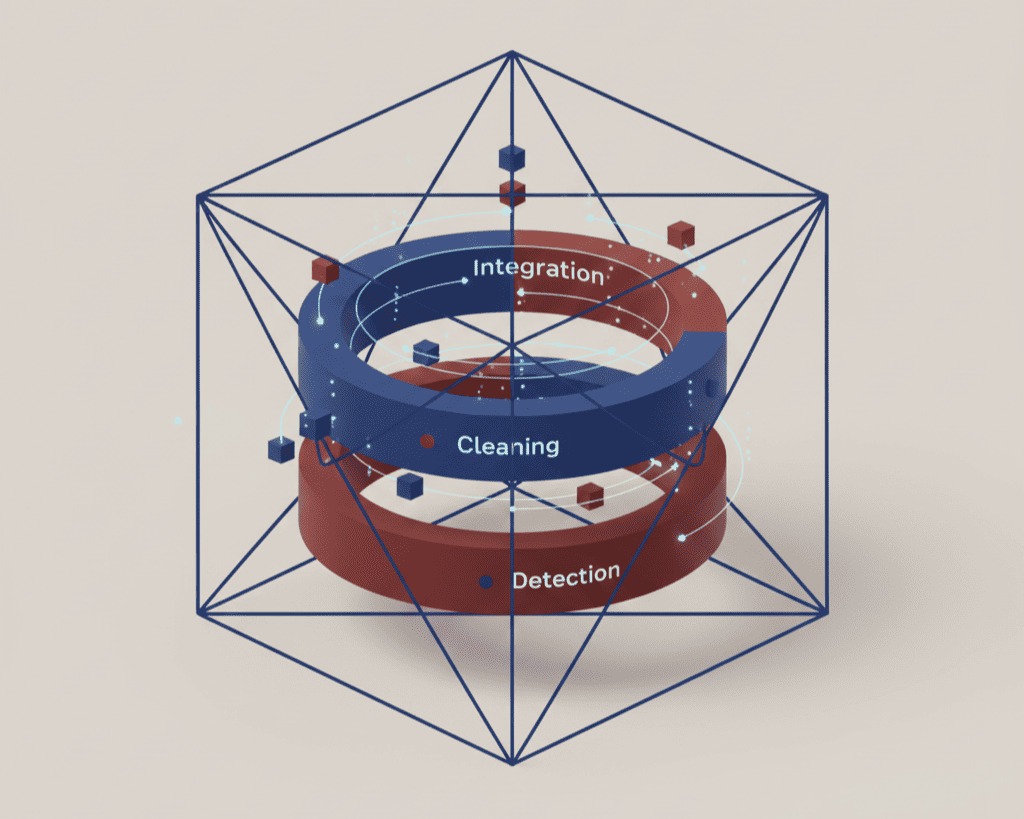
Data Integration and Quality Challenges at Scale
3.1. Data Integration as a Root Cause of Quality Issues
Integrating data from heterogeneous systems introduces semantic and structural inconsistencies. Studies show that isolated data cleaning efforts are insufficient without addressing integration-level challenges.
3.2. Self-Supervised Learning for Data Integration
Emerging approaches leverage self-supervised learning to identify similar records, learn unified representations, and support large-scale data integration without labeled data, reducing reliance on manual rules.
4. An Integrated Technical Framework for Data Quality
Recent studies propose integrated frameworks consisting of:
- Data quality issue detection using statistical and machine learning methods
- Cleaning and normalization processes
- Integration and performance evaluation layers
This framework emphasizes continuous data quality management embedded within the overall data architecture.
5. Implications for Enterprise Data Systems
Implications for Enterprise Data Systems
From an implementation perspective, organizations should:
- Treat data quality as part of system architecture
- Automate cleaning and integration processes
- Combine statistical rigor with learning-based adaptability
- Evaluate data quality based on downstream effectiveness
Data quality is not achieved through isolated techniques but through integrated systems combining data cleaning, data integration, and machine learning. As data ecosystems grow in scale and complexity, organizations must adopt holistic, system-oriented approaches to ensure sustainable data quality.At Digityze Asia, we believe that effective data solutions are built on strong technical foundations, uniting system architecture and practical implementation to help organizations unlock long-term value from their data.