In an era where businesses are increasingly data-driven, Data Extraction and Data Mining are no longer purely technical concepts reserved for IT teams. They have become foundational pillars that enable organizations to transform fragmented data into actionable business insights—insights that directly influence strategy, operations, and sustainable growth.
This article provides a practical, structured, and accessible perspective on the roles of Data Extraction and Data Mining within the data value chain, particularly suited for marketers, business leaders, and analytics teams in modern enterprises.
I. What Is Data Extraction in the Enterprise Data Landscape?
Data Extraction is the process of collecting data from multiple sources—including internal systems, SaaS platforms, databases, APIs, or web data—to support downstream processing, analysis, and value creation.
Within modern data ecosystems, Data Extraction typically serves as the entry point for processes such as:
- ETL / ELT
- Business Intelligence (BI)
- Advanced Analytics
- Data Mining and Machine Learning
Without an effective extraction layer, the entire analytics pipeline is compromised by inconsistent, incomplete, or non-scalable data.
II. The Role of Data Mining in Creating Actionable Business Insights
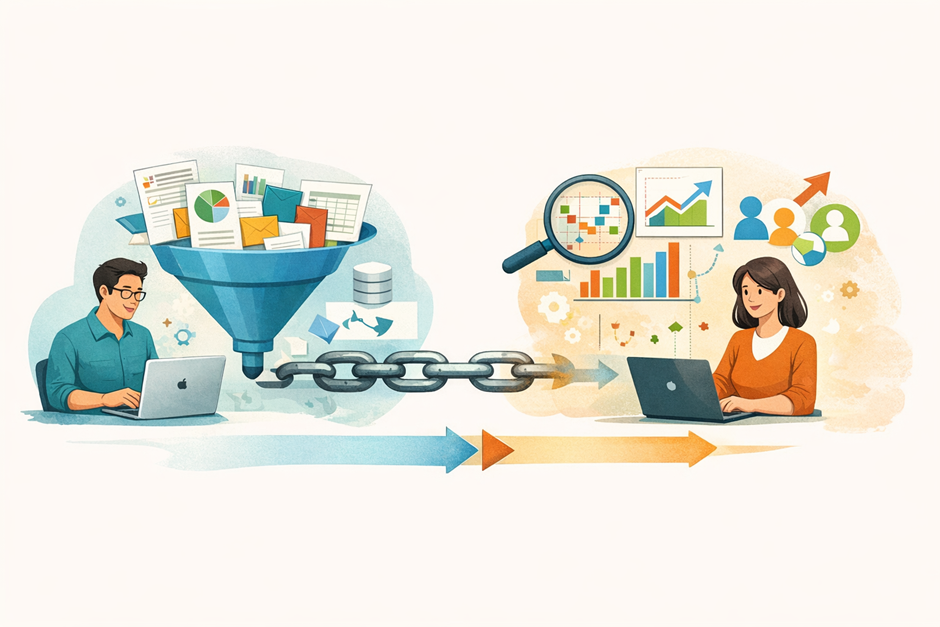
While Data Extraction focuses on data collection, Data Mining focuses on value discovery from standardized and prepared data.
Data Mining enables organizations to:
- Discover hidden behavioral patterns
- Identify trends and relationships among variables
- Predict business outcomes or customer behavior
- Support evidence-based decision-making
In practice, Data Mining only delivers value when input data is properly extracted and structured. Therefore, Data Extraction and Data Mining should be viewed as continuous, interconnected links within the same data value chain.
III. A Practical Data Extraction Process for Businesses
1. Identify Data Sources and Their Change Frequency
Organizations typically manage data distributed across:
- CRM and ERP systems
- Marketing and e-commerce platforms
- Accounting and operational systems
- External data sources such as websites or partners
Understanding the characteristics and update frequency of each source is essential for selecting the appropriate extraction method.
2. Select Data for Extraction
Not all data needs to be fully extracted. Clearly defining:
- Data for short-term analysis
- Historical data for storage
Data for reporting versus predictive modeling helps optimize both system performance and operational costs.
3. Execute Data Extraction
Data Extraction can be performed via:
- API integrations
- Direct database queries
- Automated ETL/ELT tools
Depending on scale and complexity, organizations may choose between full extraction or incremental extraction.
IV. Data Classification in Data Extraction
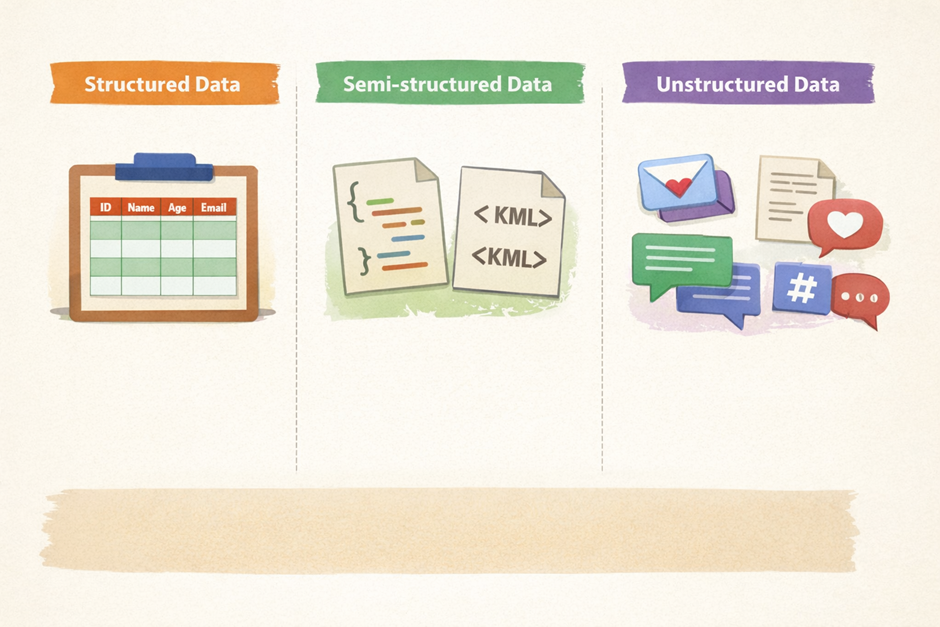
1. Structured Data
Data with a clear schema—tables, rows, and columns—commonly found in relational databases.
2. Semi-structured Data
Flexible-structure data such as JSON or XML, widely used in APIs and web applications.
3. Unstructured Data
Data without predefined structure, including emails, text content, customer feedback, and social media data—critical for behavioral and sentiment analysis.
Understanding these data types enables more effective extraction design and minimizes analytical distortion downstream.
V. From Data Extraction to Actionable Business Insights
Data Extraction alone does not create value if it stops at data collection. True value emerges only when data is:
- Cleaned and standardized
- Analyzed within a specific business context
- Aligned with strategic objectives
Through Data Mining and BI, organizations can transform data into:
- Customer behavior insights
- Operational optimization opportunities
- Early risk warnings
- Concrete action recommendations for marketing, sales, or supply chain teams
This is the true essence of actionable business insights.
VI. Data Extraction and Data Mining in the Modern BI Ecosystem
In contemporary data architectures:
- Data Extraction ensures reliable and trustworthy input data
- Data Mining unlocks strategic value
- BI and Analytics visualize insights and support decision-making
Together, these components enable organizations not just to see data, but to understand it and act upon it effectively.