Generative AI (GenAI) is becoming a strategic tool in modern businesses, not only boosting innovation but also shortening product development time. The process from prototype to commercial product is a crucial step for businesses to harness the potential of AI and create real value in the market.
- Explanation:
- Research on Transforming Business with Generative AI shows that generative AI shortens the R&D lifecycle, expands innovation, and accelerates commercialization.
- A real-world example: Eleanore (Business Insider): only 4 weeks from idea to AI-enabled product.
- Addition:
- Prototype AI is an initial test version used to verify technical feasibility and market demand.
- Identifying target customers from the early stages helps optimize the commercialization strategy.
Generative AI and the Power of Innovation in the Prototype Phase

Generative AI and the Power of Innovation in the Prototype Phase
The prototype phase is where ideas are formed and tested. Generative AI provides superior creative power, helping businesses quickly deploy multiple ideas simultaneously.
- Explanation & Examples:
- MIT Sloan: GenAI suggests new feature ideas, creating initial concepts faster than traditional methods.
- Agencies have used GPT-4 and Midjourney to create diverse prototype versions.
- Additional Note:
- Benefits for the Vietnamese Market: Startups and small and medium-sized enterprises can test AI products at low cost, reducing investment risk.
Prototype Optimization: Testing, Feedback, and Product Improvement with AI

Prototype Optimization: Testing, Feedback, and Product Improvement with AI
The process of gathering feedback and refining the product is a key factor in transforming a prototype into a stable, commercially ready product.
- Explanation & Examples:
- AI models analyze survey data and feedback from test groups, providing insights for product improvement.
- Case study: Eleanore: AI analyzes market data and adjusts the product quickly, shortening the development cycle.
- Evidence:
- MIT Sloan: feedback is transformed into insights to refine the product before commercialization.
- Additions:
- Implementation methods: A/B testing, user testing, iterative design.
- Optimizing user experience and market orientation early on.
Strategy for Success: Commercializing Generative AI Products
Strategy for Success: Commercializing Generative AI Products
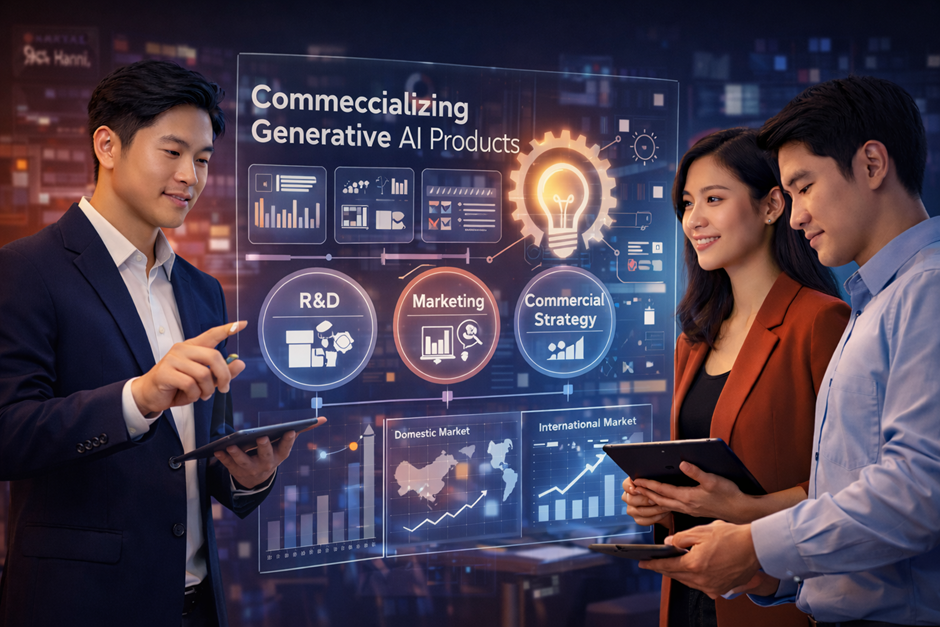
Commercialization is not just about technology, but also about business strategy. Bringing AI products to market requires a combination of R&D, marketing, and commercial strategy.
- Explanation & Examples:
- Research on Transforming Business with Generative AI: AI products help open up new product lines, new business models, and create real value.
- Case study: Eleanore: AI is used to design brands, build market entry strategies, and shorten the time to take products from prototype.
- Additional points:
- Key considerations: AI governance, AI ethics, and legal compliance.
- Strategies for Vietnamese businesses: combine domestic and international markets, choose a suitable niche, and conduct a clear cost-benefit assessment.
Challenges and Lessons Learned When Deploying Generative AI into a Product

Challenges and Lessons Learned When Deploying Generative AI into a Product
Despite its many advantages, the commercialization of AI faces technical, legal, and market barriers.
- Explanation & Examples:
- Ethical and governance issues: ensuring AI transparency and avoiding bias.
- Technical difficulties: small prototypes are difficult to scale.
- Eleanore Case Study: optimizing AI collaborators is necessary for workflow synchronization.
- Additions:
- Solutions: invest in infrastructure, train personnel, and set clear KPIs for AI projects.
- Lessons Learned: start with small prototypes, continuously experiment, and scale intelligently.
The Future of Generative AI: The Journey from Prototype to Product

The Future of Generative AI: The Journey from Prototype to Product
Generative AI opens opportunities to shorten product lifecycles, open new markets, and create a competitive advantage.
- Explanation & Examples:
- Insights from 3 reference papers: AI accelerates innovation, refines products, and helps bring them to market faster.
- The Eleanore and MIT Sloan case study illustrates practical feasibility.
- Additions:
- Proposed roadmap: from prototype → product → successful commercialization for Vietnamese and international businesses.
- Recommendations: small-scale deployment, continuous improvement, integration of data, marketing, and business strategy.
Conclusion
Commercializing Generative AI is a journey from idea → prototype → final product, requiring both technical expertise and strategic planning. Businesses can:
- Shorten R&D time and increase innovation with AI.
- Optimize the feedback loop and refine products quickly.
- Apply smart market strategies and expand domestically and internationally.
- Manage risks, adhere to AI ethics, and ensure governance.
To turn your Generative AI idea into a successful commercial product, contact Digityze Asia – a specialist in Digital Marketing & Technical Solutions, helping Vietnamese and international businesses deploy AI from prototype to market quickly and effectively.