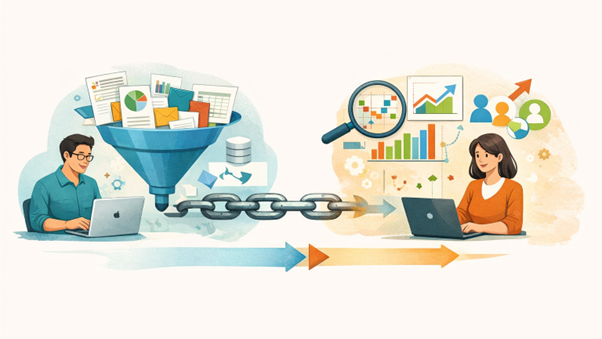
Digital Transformation (DX) is no longer an option, but a mandatory requirement for maintaining competitiveness. However, many businesses fail, not due to lack of capital or technology, but due to the absence of a clear, detailed Digital Transformation Roadmap (DX Roadmap).
This article, based on analysis from leading experts in strategy and technology, provides a detailed 5-stage guide for building and executing a successful DX Roadmap, helping leaders overcome obstacles and realize core business objectives.
1. What is a DX Roadmap? Its Pivotal Role in the Digital Transformation Strategy
The Digital Transformation Roadmap (DX Roadmap) is a detailed, time-bound action plan designed to connect a company’s long-term Strategic Vision with specific Digital Initiatives.
The Role of the Roadmap vs. Strategy
- The DX Strategy answers “Why” and “Who we want to become” (defining business objectives).
- Conversely, the DX Roadmap answers “How” (the execution plan, resource allocation, and timeline).
Core Benefits of a Clear Roadmap
- Creates Transparency: Provides Leadership and employees with a comprehensive view of the progress and dependencies between projects.
- Mitigates Risk: Breaks down large projects into smaller, manageable Phases.
- Optimizes Resources: Allocates budget, personnel, and time precisely based on priority levels.
2. Stage 1: Defining the Vision and the Digital Transformation Assessment Framework

This foundational stage ensures that the DX project serves the core business objectives, rather than merely chasing technological trends.
2.1. Current State Analysis and Maturity Assessment
Before determining the destination, the organization must know its starting point. The assessment framework typically focuses on 5 Core Pillars of Digital Transformation:
- Customer: Level of understanding and digital interaction channels.
- Data: Ability to collect, analyze, and utilize data for decision-making.
- Operations: Automation level of internal processes and the supply chain.
- Technology: Status of IT infrastructure, and readiness for Cloud and new platforms.
- People & Culture: Willingness of employees to learn, experiment, and embrace change (Digital Culture).
2.2. Mapping the Gaps (Gap Analysis)
Gap Analysis is the process of comparing the assessed Current State (AS-IS) with the desired Target State (TO-BE) (the DX Vision).
- The result is a list of gaps in Capabilities, Technology, and Processes that need to be filled.
- These gaps form the basis for defining the Work Packages within the Roadmap.
3. Stage 2: Prioritization and Planning by Work Packages (Phasing)
An effective Digital Transformation Roadmap is a balanced combination of short-term projects (Quick Wins) and long-term strategic initiatives.
3.1. Prioritization Matrix: Impact vs. Feasibility
DX projects should be ranked using a two-dimensional matrix:
- Impact: The level of effect on business goals (Revenue increase, Cost reduction…).
- Feasibility: The ease of implementation (Cost, Technical risk, Personnel readiness).
Organizations should select High Impact/High Feasibility projects (Quick Wins) to build momentum, followed by strategic projects requiring more careful resource allocation.
3.2. Project Timeline Sequencing
The Roadmap must be divided into manageable Phases or Sprints (e.g., Phase 1: Foundation & Data; Phase 2: Customer Experience Optimization). This approach helps to:
- Allocate budget and resources clearly for each phase.
- Determine Dependencies – for example, AI Chatbot deployment depends on the completion of Customer Data standardization.
4. Stage 3: Execution and Integration of Digital Transformation Technology
This is the stage of transforming the plan into tangible action.
4.1. The Role of Technology (AI, IoT, Cloud, Data Analytics)
Technology is not the goal, but the means to address the identified gaps and realize business objectives. Technology selection (e.g., migrating systems to the Cloud for scalability, using Data Analytics to optimize the supply chain) must be guided by the prioritized Roadmap.
4.2. Change Management and Workforce Training
Change Management is often the critical factor for DX project failure. Organizations must invest in:
- Communication: Clearly explaining the “Why” behind the change and its benefits to individuals and the company.
- Training: Ensuring employees have the necessary skills to use the new systems, driving end-user acceptance (User Adoption).
5. Stage 4: Operations and Continuous Assessment (Continuous Improvement)
Digital Transformation is an ongoing process, not a project with a finish line.
Setting Performance Indicators (KPIs) for DX
Assessment must be based on Outcome-based KPIs (Indicators based on Business Results) rather than solely Output-based KPIs (Indicators based on Technical Deliverables).
- Good (Outcome-based): Increasing Customer Satisfaction Score (CSAT) by 15%; Reducing operational costs by 10% through automation.
- Less Effective (Output-based): Completed CRM system implementation; Finished 50% of the project.
Continuous assessment allows the organization to adjust the Roadmap flexibly (Agile), ensuring it remains relevant to market and technological changes.
Conclusion: Digital Transformation is a Cultural and Technological Journey
Building a Digital Transformation Roadmap (DX Roadmap) is a complex process requiring leadership commitment, planning transparency, and execution flexibility. Success does not come from adopting the most expensive technology, but from having a systematic Roadmap that tightly integrates Business Strategy and Technological Capabilities.
How can we assist with your Roadmap?
At Digityze Asia, we combine a solid Technical foundation (Technical Solutions) with Creative strategic capabilities.
If your business is facing challenges in building a detailed Digital Transformation Roadmap, or needs to realize complex digital initiatives, we are ready to listen and co-design the successful map for your digital future. We don’t just provide technology; we provide comprehensive solutions to ensure your roadmap achieves your business goals.