
The automated marketing content creation process powered by generative AI
Generative AI is rapidly becoming a strategic tool that enables businesses to automate marketing content creation at scale, while still maintaining personalization and brand consistency. This article examines how generative AI is applied in content marketing, the tangible benefits it delivers, key risks to manage, and how organizations can implement it effectively.
I. Why generative AI is transforming how businesses create marketing content
In a digital-first era, content is no longer just about volume—it must reach the right audience, at the right time, and in the right context. Today’s businesses are required to produce hundreds, even thousands, of content variations across websites, social media channels, email marketing, and multi-channel advertising.
Insights from the referenced articles highlight several limitations of traditional manual content production models:
- High time and labor costs
- Difficulty scaling content output as demand increases
- Limited ability to deeply personalize content for different audience segments
This is where generative AI emerges as a foundational technology, enabling the automation of marketing content creation while preserving quality and strategic intent.
II. What is generative AI in the context of modern marketing?
1. Defining generative AI in marketing
Generative AI refers to a class of artificial intelligence models capable of producing new content—such as text, images, video, and code—based on training data and input prompts.
In marketing, generative AI goes beyond simply “writing content.” It functions as an automated content generation system, supporting marketers from ideation through execution.
2. How generative AI differs from traditional automation
Unlike rule-based automation tools, generative AI systems can:
- Understand context and content objectives
- Produce multiple content variations from a single marketing brief
- Learn and improve based on data and user feedback
This capability unlocks the potential to scale marketing content in ways that were previously difficult to achieve.
III. Applications of generative AI in automating marketing content creation
1. Automating multi-channel content creation
Generative AI can support:
- SEO-optimized blog writing
- Platform-specific social media content
- Personalized email marketing copy
- Advertising content with multiple messaging variations
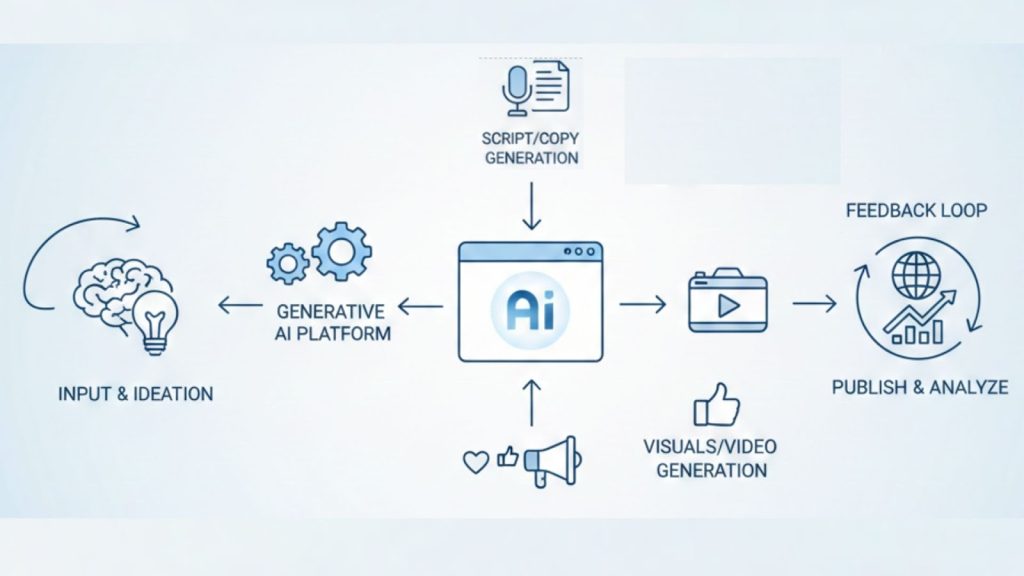
Marketing content creation workflow powered by generative AI
2. Personalizing content using customer data
When combined with a Customer Data Platform (CDP) or Customer Relationship Management (CRM) system, generative AI enables businesses to:
- Deliver content tailored to specific customer segments
- Personalize messaging based on behavior and interaction history
- Increase email open rates and conversion performance
According to the reference articles, this is one of the most significant distinctions between AI-generated and optimized content and mass-produced content.
3. Supporting ideation and content optimization
Generative AI does not replace strategic thinking. Instead, it:
- Suggests headlines and content angles
- Recommends article structures
- Optimizes keywords and content semantics for SEO
This allows marketing teams to reduce time spent on repetitive tasks and focus more on strategy and customer insights.
IV. Strategic benefits of applying generative AI to content marketing
1. Accelerating content production speed
Businesses can significantly shorten the time from ideation to publication, particularly for fast-moving campaigns.
2. Reducing marketing operational costs
Partial automation of content workflows helps:
- Alleviate staffing pressure
- Optimize outsourcing expenses
- Improve the productivity of existing marketing teams
3. Maintaining brand consistency
When properly configured, generative AI can:
- Adhere to brand guidelines
- Maintain a consistent tone of voice
- Minimize messaging inconsistencies across channels
V. Risks and technical considerations when deploying generative AI
1. Quality control challenges
Although generative AI can produce content rapidly, it is not always contextually accurate. As a result, a human-in-the-loop review model is essential.
2. SEO and content duplication risks
- Lacks depth
- Repeats similar ideas
- Fails to meet Google AI Overview criteria
Improper use of AI may result in content that:
Prompt refinement and post-generation content review are therefore critical.
VI. How Digityze Asia helps businesses leverage generative AI effectively and sustainably
At Digityze Asia, we view generative AI not merely as a content-writing tool, but as an integral part of a broader Marketing & Technology Solutions ecosystem.
We help businesses:
- Design generative AI workflows aligned with business objectives
- Standardize prompts, guidelines, and content workflows
- Integrate AI with data, SEO, and brand strategy
- Ensure AI-generated content delivers performance while protecting brand integrity
Conclusion
Generative AI is ushering in a new era of automated marketing content creation—one in which businesses can scale content production without sacrificing quality or personalization. However, to realize its full value, generative AI must be deployed with the right strategy, technical rigor, and governance.
If your organization is seeking a solution that blends technology with creativity, Digityze Asia is ready to partner with you to implement generative AI in a practical, sustainable way—aligned with your long-term growth objectives.