
Data is often hailed as the “new oil.” But raw oil is useless until it’s refined. The same applies to data. Many businesses are sitting on mountains of information but lack the tools to turn it into a competitive advantage. So, what is Big Data, really? And how can dry numbers translate into cost savings and revenue growth?
This article provides a comprehensive, beginner-friendly guide to unlocking the hidden value of your business data.
Redefining Big Data in the Digital Age
Simply put, Big Data refers to datasets so voluminous, fast-moving, and complex that traditional data processing software (like standard spreadsheets or simple relational databases) just can’t manage them.
But it’s not just about size. According to Forbes, every digital action leaves a “digital trace.” From GPS signals and credit card transactions to social media likes—everything generates data.
For a technology or marketing professional, Big Data isn’t just about storage capacity; it’s about the ability to analyze this chaotic information to uncover insights that drive smarter business decisions.
Decoding the 5Vs: The DNA of Big Data
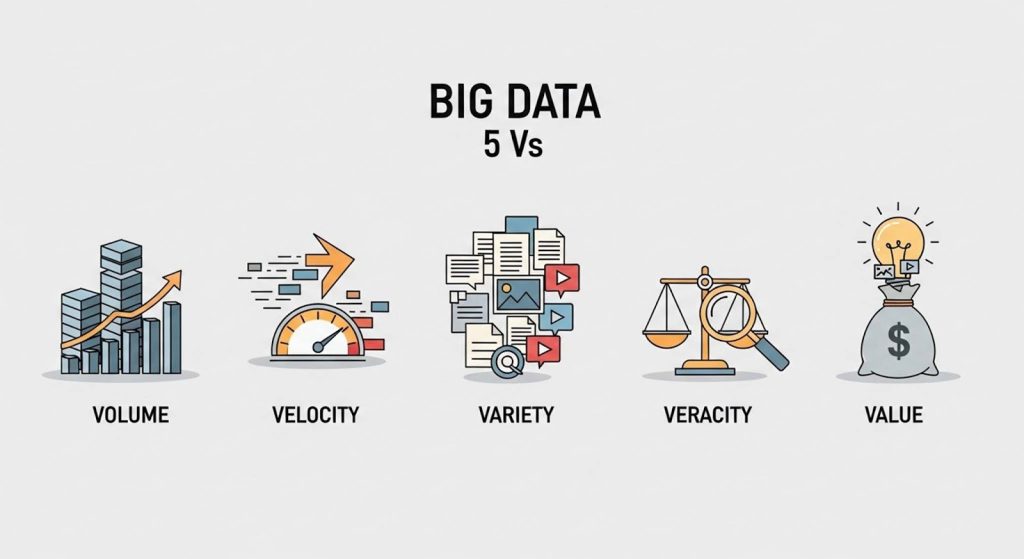
To understand the nature of Big Data, industry experts (including those at IBM) often refer to the 5Vs. This framework helps businesses determine if they are truly dealing with Big Data challenges.
1. Volume
This is the most obvious characteristic. Organizations collect data from endless sources: transactions, IoT devices, industrial equipment, videos, and social media. Thanks to Cloud computing and Data Lakes, storing this massive volume has become significantly more affordable.
2. Velocity
Velocity refers to the speed at which data is generated and processed. In the era of the Internet of Things (IoT), this often means “real-time.” RFID tags, smart sensors, and stock market feeds require immediate processing to prevent information bottlenecks.
3. Variety
This is often the biggest technical challenge. Data no longer fits neatly into rows and columns (Structured Data). It now includes:
- Unstructured Data: Text documents, videos, audio, social media posts.
- Semi-structured Data: System logs, XML files. Managing this variety requires specialized integration solutions.
4. Veracity
Veracity refers to the trustworthiness of the data. Is the data clean, or is it full of noise and errors? If the input data is “garbage,” the analytical output will be worthless (“Garbage In, Garbage Out”).
5. Value
The final and most critical V. Data is meaningless unless it translates into value. This value could be operational cost reduction, deeper customer understanding, or the discovery of entirely new market segments.
Why Big Data Matters for Modern Enterprises
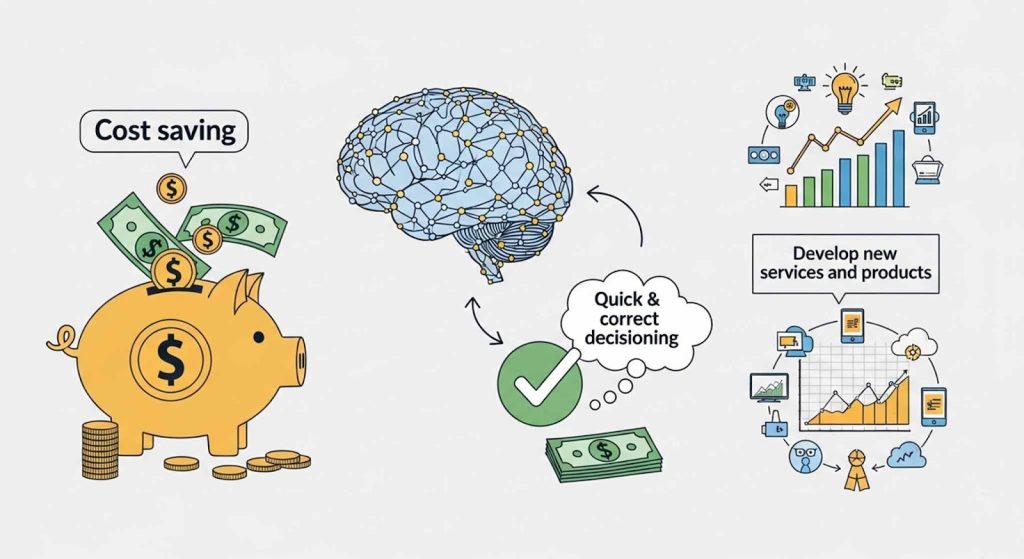
It is no coincidence that both Fortune 500 companies and agile SMEs are heavily investing in data technology. Market analysis highlights three strategic benefits:
- Cost Reduction: Modern data platforms (like Hadoop or Cloud-native solutions) offer cost-effective storage. Furthermore, analytics can identify inefficiencies in operations, helping to cut waste.
- Faster, Better Decision Making: With in-memory analytics, businesses can analyze information immediately to make decisions in real-time, rather than waiting for end-of-month reports.
- New Products and Services: By analyzing customer needs and behaviors through Big Data, companies can understand what customers actually want, allowing them to innovate products that solve real market pain points.
The 5-Step Process to Unlock Data Value
To turn abstract concepts into tangible results, businesses need a clear roadmap. Combining IBM’s technical framework with practical management strategy, here are the 5 steps to implement Big Data effectively:
Step 1: Define Strategy Before buying technology, ask: “What business problem are we solving?” Don’t collect data just for the sake of it. Define your goal: Reducing churn? Optimizing inventory? Personalizing CX? A clear strategy guides the entire process.
Step 2: Integrate (Ingestion) Data is often siloed: customer info in CRM, orders in ERP, interactions on Social Media. The challenge is to ingest these diverse sources (structured and unstructured) into a unified system where they can “talk” to each other.
Step 3: Manage (Storage & Governance) Once collected, data needs a secure home. Depending on scale, this could be On-premise, Cloud, or a hybrid Data Lake. The core requirement here is ensuring security, compliance, and data hygiene.
Step 4: Analyze This is where the magic happens. Clean data is fed into analytical models. Techniques like Data Mining, Predictive Analytics, or Machine Learning are applied to uncover patterns invisible to the naked eye.
Step 5: Visualize & Act Analytical results are useless if they are too complex for stakeholders to understand. The final step uses Dashboard tools (like PowerBI, Tableau, Looker) to visualize the data, telling a compelling business story that empowers leaders to take Action.
Real-World Applications: When Data Tells a Story
- Marketing & CX: Look at Netflix or Amazon. They don’t just sell products; they sell understanding. By analyzing the history of millions of users, Recommendation Engines provide suggestions so accurate that users feel the platform “reads their minds.”
- Product Development: Companies use predictive models to anticipate market trends, adjusting product features before competitors even spot the shift.
- Operations: Data from industrial sensors can predict equipment failure, allowing for predictive maintenance that prevents costly downtime.
Conclusion
What is Big Data? It is not just technology; it is a new management mindset. In a hyper-competitive market, those who own the data and know how to exploit it will lead the pack.
However, the journey from raw data to valuable insight is complex. It requires a seamless blend of Technical Infrastructure and Strategic Thinking. Don’t let technical complexity hold your business back.
If you are looking for a partner who can provide both strategic consulting and comprehensive digital implementation, let Digityze Asia guide you. We believe that by combining creativity with a robust technical foundation, we can unlock the potential hidden within your enterprise data.