Why Businesses Need to Assess Readiness Before Digital Transformation
In consulting with businesses across Vietnam, the U.S., and Asia, we observe a recurring pattern: digital transformation often begins with technology but fails due to the lack of an appropriate organizational foundation.
Many companies invest in CRM, ERP, marketing automation, or AI when:
- Strategy is unclear
- People are not ready
- Processes still follow old ways of working
- Data is fragmented and unusable
Academic research and international consulting reports consistently show that digital transformation failures rarely stem from a lack of technology; they are usually caused by misjudging an organization’s actual readiness.
Digital readiness is not just an IT issue. It is the intersection of:
- Strategy and governance
- Technology infrastructure & data
- Human capabilities
- Operational processes
- Customer-centric culture and mindset
This article consolidates academic and practical perspectives into a 5-step digital readiness assessment framework to help businesses understand their current position before moving forward.
Step 1: Clarify Strategic Objectives and Leadership Alignment.

Clarify strategic objectives and leadership alignment
“Digital transformation must start with strategy, not technology.”
In international consulting projects, the first step is always to determine which business objectives digital transformation serves. Without senior leadership alignment, all subsequent assessments are unreliable.
Key strategic questions to answer:
- What problems is digital transformation expected to solve? (growth, cost optimization, customer experience, market expansion…)
- Do leaders share a common vision regarding the role of technology?
- Are decision-making mechanisms, budgets, and responsibilities for digital initiatives clearly defined?
Academic research shows that lack of strategic alignment often causes businesses to overestimate their readiness, leading to unrealistic expectations and partial implementation.
Expected outcome:
- A unified strategic foundation that serves as a reference point for the entire assessment and digital transformation process.
Step 2: Assess Current Technology and Data Infrastructure.
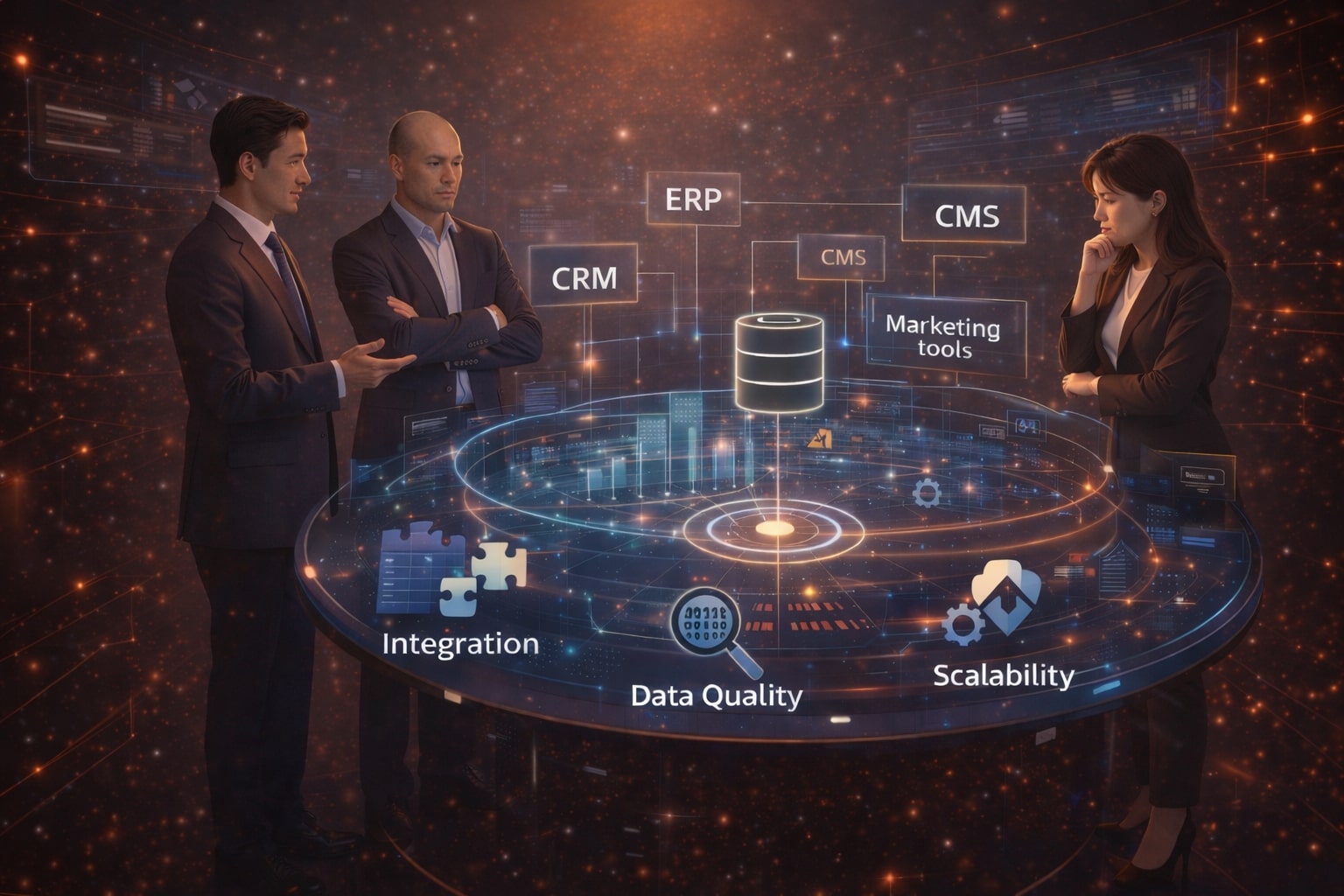
Assess current technology and data infrastructure
“Technology is a necessary condition, but never sufficient.”
International digital transformation frameworks focus less on the number of systems a business has, and more on:
- Whether those systems are connected
- Whether data can be leveraged for business decisions
- Whether the infrastructure can scale and adapt over the next 3–5 years
Key aspects to evaluate include:
- Integration level across systems (ERP, CRM, CMS, marketing tools…)
- Data quality, consistency, and accessibility
- Degree of automation in core processes
- Infrastructure stability, security, and scalability
Many businesses have modern technology but in silos, making data fragmented and significantly lowering digital readiness.
Expected outcome:
- A clear understanding of whether technology truly supports or hinders the digital strategy.
Step 3: Assess Human and Organizational Capabilities.

Assess human and organizational capabilities
“Digital transformation is a change in how work is done, not just the deployment of new systems.”
In both Vietnam and international markets, the biggest gaps are often not in technology but in people and organizational capabilities.
Assessment should cover:
- Availability of digital skills, data analysis, and technology mindset
- Training, capability development, and continuous learning mechanisms
- Cross-departmental collaboration capabilities in digital projects
- Innovation mindset and readiness to embrace change
Instead of evaluating individuals, international models recommend assessing overall organizational capabilities, where people, structure, and collaboration determine success potential.
Expected outcome:
- Clear identification of digital capability gaps to address before or alongside technology implementation.
Step 4: Review Processes, Culture, and Customer-Centricity

Review processes, culture, and customer-centricity
“Technology cannot save an organization with rigid processes and a change-resistant culture.”
Research shows that organizations with low digital readiness often share:
- Complex, inflexible processes
- Slow, centralized decision-making
- Limited use of customer data to improve experience
- Reluctance to experiment and fear of failure
Key factors to evaluate:
- Flexibility of operational processes
- Speed of decision-making and delegation of authority
- How the business collects and uses customer data
- Readiness to experiment, learn quickly, and continuously improve
In many cases, the greatest barriers to digital transformation are not technological but cultural and operational.
Expected outcome:
- Identification of non-technical barriers limiting digital transformation effectiveness.
Step 5: Identify Gaps and Build a Prioritized Digital Transformation Roadmap.

Identify gaps and build a prioritized digital transformation roadmap
“Assessment is only valuable if it leads to concrete action.”
An effective digital readiness assessment should translate into a clear, prioritized transformation roadmap, rather than scattered initiatives.
A practical roadmap typically:
- Links capability gaps to business objectives
- Prioritizes by impact and feasibility
- Breaks down into measurable, adjustable phases
International models also recommend periodic readiness evaluations to update strategies according to organizational and market evolution.
Expected outcome:
- A feasible digital transformation roadmap aligned with current capabilities and scalable for the future.
Quick Summary
The 5 steps to assess digital readiness:
- Clarify strategic objectives and leadership alignment
- Assess technology and data infrastructure
- Assess human and organizational capabilities
- Review processes, culture, and customer orientation
- Identify gaps and build a prioritized roadmap
This approach helps businesses reduce risks and focus on the right priorities during digital transformation.
Concluding Perspective
Academic research and international consulting experience show that sustainable digital transformation always begins with understanding the organization’s readiness.
Accurate assessment allows a business to move cautiously in the early stages, yet achieve long-term, sustainable success.
At Digityze Asia, we approach digital transformation as a combination of strategy, technology, and people. Digital readiness assessment is not about creating complex models but about helping businesses understand where they stand and what to prioritize next.
If your business is considering digital transformation and needs a systematic, practical, and internationally aligned perspective, Digityze Asia is ready to provide open and careful consultation.