In an era of constant volatility, Southeast Asia is shedding its old skin to embrace the identity of a next-generation “Silicon Valley.” We no longer stand at the threshold of change; we are in the eye of a digital transformation storm.
If the traditional economy is likened to trail paths, digital transformation is the high-speed expressway connecting ASEAN nations into a unified bloc. However, behind the “dizzying” growth figures lies a challenging puzzle of adaptation and execution for every business. To understand where we stand and what opportunities lie ahead, let us unpack the panoramic view of the regional digital economy – a place where old boundaries are being broken to make way for a trillion-dollar era.
1. Southeast Asia 2025: When Digital Transformation is no longer an “Option,” but a “Common Language”

Over the past decade, Southeast Asia has shed its image as a “developing” market to become the epicenter of the global digital economy. With a projected milestone of $1 trillion by 2030, we are not just talking about an increase in Internet users, but witnessing a comprehensive restructuring.
The emergence of the ASEAN Digital Economy Framework Agreement (DEFA) is not merely a legal document; it is an affirmation of a borderless market. Here, Digital Transformation (DX) acts as a “common language” that blurs geographical boundaries, allowing an SME in Vietnam to operate a seamless supply chain to Singapore or Indonesia through an integrated ecosystem.
2. Decoding the “Singapore Miracle”: From Hard Infrastructure to “Trust” Infrastructure
If Smart Nation 1.0 was a story of connecting infrastructure and data, then Singapore’s Smart Nation 2.0 is the most valuable lesson in digital governance philosophy. Singapore understands that: Technology can be bought, but Trust must be built.
Case Study: AI Governance and the “Human-Centric” Pivot
Singapore has wisely avoided chasing the AI arms race in terms of speed, focusing instead on AI Governance.
- Deep Analysis: Rather than letting businesses drift in a sea of data, the Singapore government creates legal frameworks and support tools to ensure AI is “transparent” and “ethical.” This provides local businesses with a prestigious “passport” when entering the international market—where data security standards are becoming stricter than ever.
- Implementation Value: The lesson for Vietnamese businesses is: Do not just digitize to be faster; digitize to be more trustworthy. A digital identity system like SingPass is not just a login tool; it is a symbol of an economy operating on absolute transparency.
3. Top DX Trends 2025: The “Touchpoints” Changing the Game
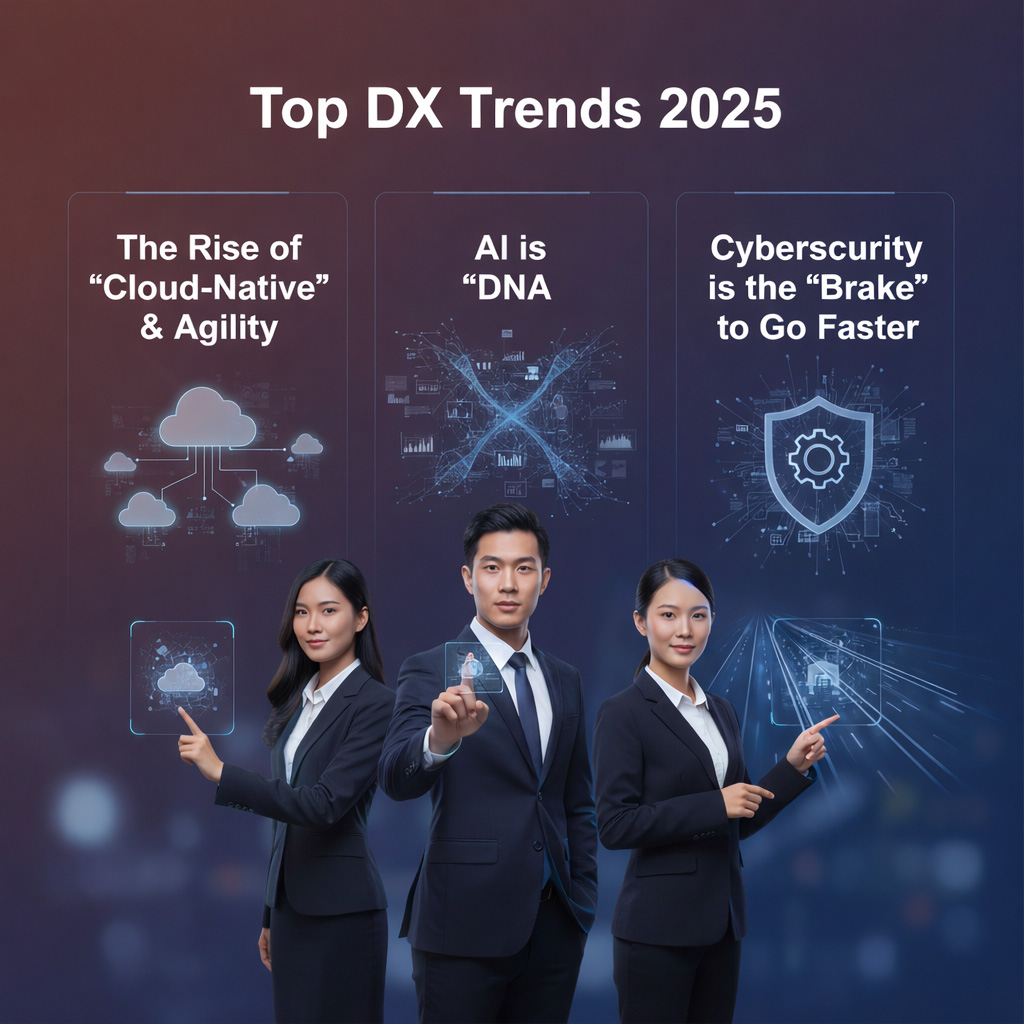
To avoid being left behind in the ASEAN value chain, businesses must pay close attention to the following three strategic shifts:
3.1. The Rise of “Cloud-Native” and Agility
In a volatile market, cumbersome, on-premise ERP systems are revealing their weaknesses. The shift toward Cloud-Native allows businesses to react instantly to market changes. In Singapore, “Cloud-First” has become the mantra for maintaining maximum operational flexibility.
3.2. AI is no longer an “Add-on,” AI is “DNA”
By 2025, AI will no longer be a feature added to a website. It permeates every stage of the value chain: from forecasting logistics demand to deep-level personalization of customer experiences. Successful businesses are those that dare to place AI at the core of their business model rather than just using it for fragmented tasks.
3.3. Cybersecurity is the “Brake” to Go Faster
Many businesses view Cybersecurity as a cost that hinders speed. But looking at Singapore, cybersecurity is the high-quality brake system that helps the “business car” confidently accelerate on the digital highway. Without security, all DX efforts can collapse after a single data breach.
4. Breakthrough Roadmap for Businesses: Global Vision, Local Execution
The gap between a business that is “digitizing” and one that is “digitally successful” is Digital Culture.
- Ecosystem Thinking: Do not try to build a technological “oasis.” Learn to connect to the general ecosystem, using shared platforms to optimize resources.
- People as the Core: Technology is the variable, people are the constant. Investing in Upskilling for staff is the investment with the highest ROI (Return on Investment) in any DX project.
5. Conclusion
Digital transformation in Southeast Asia is entering a golden age. The lessons from Singapore are not just theories but a practical compass for any business aspiring to reach regional heights. Success will only come to those who dare to change their mindset from “using technology” to “operating by technology.”
At Digityze Asia, we do not believe in cookie-cutter technology solutions. Every business is a living entity with its own unique cultural traits. By combining precise Technical thinking with limitless Creativity, we humbly walk alongside you to find the most “tailor-made” digitalization roadmap. You don’t need to be a giant to start transforming; you just need a partner empathetic enough to go with you to the very end of the change.